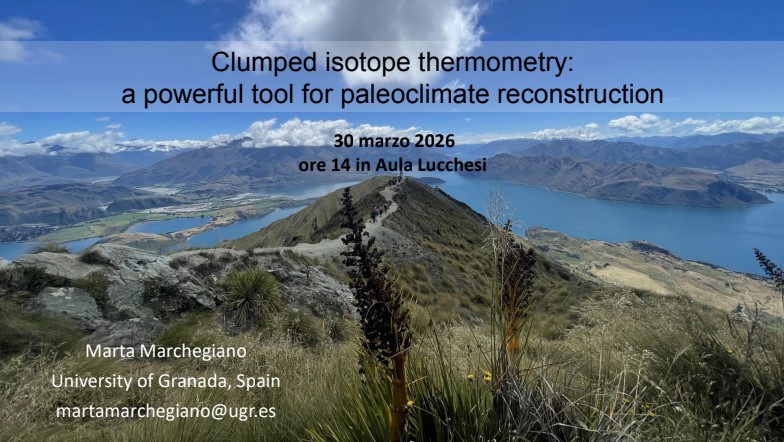
30/03/2026
This seminar will provide a detailed overview of this technique, explaining how temperature data is derived from carbonates and how this approach can help answer fundamental questions about the climate of the past.
Particular attention will be devoted to the reconstruction of climatic seasonality in continental environments, a key aspect for understanding the Earth’s climate system beyond annual averages. Non-marine carbonate archives are, in fact, valuable yet complex records, the interpretation of which requires in-depth knowledge of the environmental and biological processes that control carbonate formation.
The work presented analyzes the clumped isotope signal in carbonates from modern and fossil ostracod valves (benthic microcrustaceans with bivalve shells composed of low-Mg calcite) from freshwater environments, along with modern and Miocene sabkha carbonates, with the aim of investigating seasonal temperature variability in continental settings.
The results show that the type of carbonate and the setting of formation strongly influence the temperatures derived from clumped isotopes, highlighting the risk of misinterpretation when these factors are not adequately taken into account. The integration of sedimentological, biological, and geochemical information is therefore essential for constraining the timing and conditions of carbonate precipitation and improving paleoclimate reconstructions in continental environments.